
Innovative health-preserving and regeneration therapies in Budapest, at Mammut. Opening: autumn 2026


Cryotherapy: how does it work, what is it used for, who can it be recommended for and how does a treatment work?
Cryotherapy – that is cold therapy – is an umbrella term: it covers every procedure that uses low temperatures for therapeutic purposes. From icing and local cold treatment all the way to whole-body cryochambers and cryo saunas, there are several different methods.
In recent years cryotherapy has been sought out primarily for recovery, to support sports performance, to improve well-being and as a complementary treatment for certain complaints. It is important, however, to separate cryotherapy for wellness and recovery purposes from medical cryotherapy: in medicine, cryotherapy may mean, for example, a dermatological treatment using liquid nitrogen or the targeted freezing of tissues.
In this article we deal with whole-body cryotherapy for recovery purposes – with what cryochambers and cryo saunas offer.
What is cryotherapy?
The word „cryo” means cold. The basic principle of cryotherapy is that the body is exposed to an intense cold effect for a short time. During whole-body cryotherapy the air temperature may drop even below –100 °C, while the treatment itself typically lasts only a few minutes.
This sounds extreme at first, but there is an important difference in that we are talking about dry, very cold air . The thermal conductivity of air is considerably lower than that of water, so in a few minutes the core temperature of the body does not drop to the extent one would think on the basis of the temperature measured in the chamber. It is primarily the skin and the surface tissues that cool down, to which the body responds with several physiological reactions.
During the cold exposure the blood vessels temporarily contract and the blood flow in the skin changes; then after the treatment, on returning to normal temperature, they dilate again. In parallel with this, the functioning of the nervous system, the circulation and certain inflammatory processes may also change.
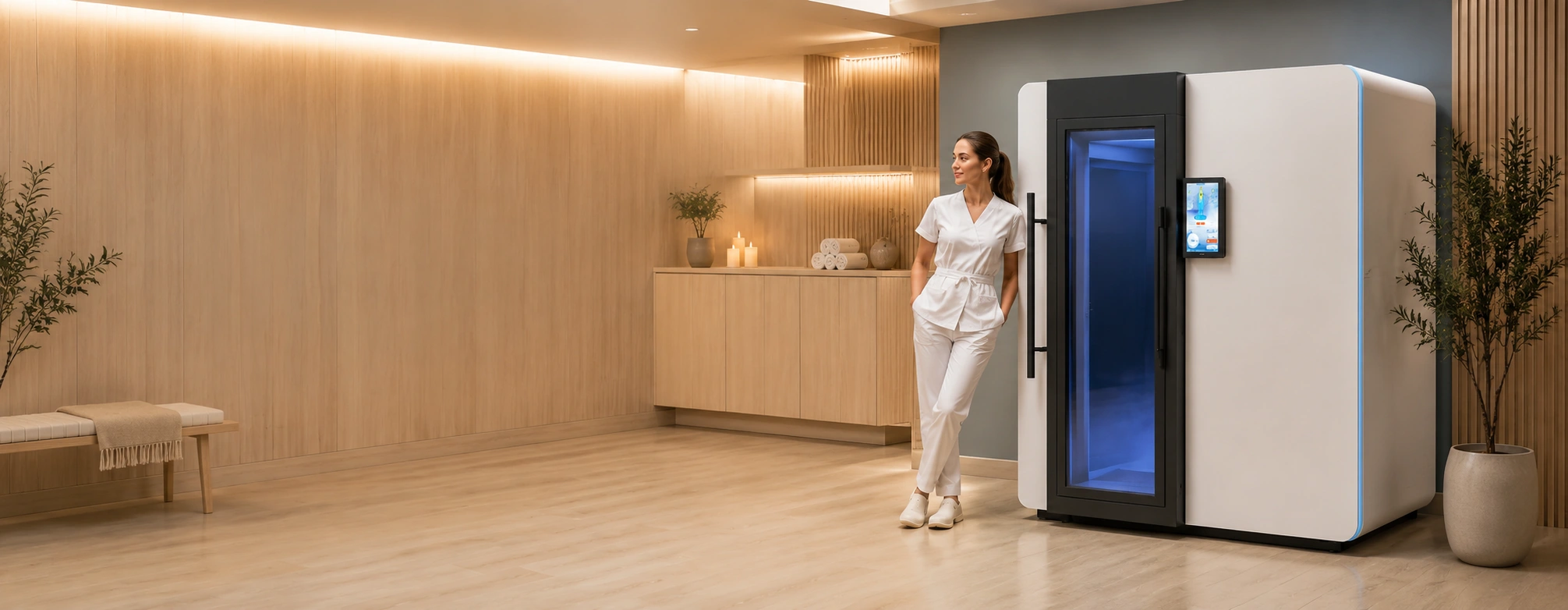
What are the types of cryotherapy?
Cryotherapy does not mean a single treatment. Several different methods may be used, depending on whether the aim is to expose the whole body or only a smaller area to cold.
- Local cryotherapy – only a given body part is cooled, for example the knee, shoulder or ankle after sport. This also includes certain forms of icing, cold air treatments and special local cryotherapy devices.
- Whole Body Cryotherapy (WBC) – the guest enters a chamber in which the whole body, typically including the head, is surrounded by extremely cold, dry air.
- Partial Body Cryotherapy (PBC) – most of the body is in a cold environment, while for example the head may stay outside the chamber.
The literature treats WBC and PBC separately, so results relating to one cannot always automatically be applied to the other. In addition, there are also medical cryotherapy procedures serving a completely different purpose: in dermatology, for example, liquid nitrogen may be used to remove certain lesions, and during cryoablation abnormal tissues are destroyed in a targeted way with extreme cold. These are medical interventions and are not the same as cryotherapy for recovery purposes.
How does whole-body cryotherapy work?
The body naturally tries to maintain a constant internal temperature. When the skin is suddenly placed in a very cold environment, several defence mechanisms are triggered.
The contraction of the peripheral blood vessels reduces the blood supply of the skin, thereby limiting heat loss. After the treatment ends, when the body returns to an environment of normal temperature, the vessels gradually dilate. Cold also acts on the sensory receptors of the nervous system – this may partly explain why some people report a temporarily reduced sensation of pain or a fresher feeling after the treatment.
What does the research say?
According to a meta-analysis published in 2025 combining 11 randomised controlled trials, whole-body cryotherapy may influence the level of certain inflammatory markers, and the results appeared particularly favourable in the case of athletes. The combined number of participants in the studies was only 274 people, however, so the results still have to be interpreted with caution.
What can cryotherapy be good for?
The most common area of use of whole-body cryotherapy is recovery.
Recovery after sport and training
Cryotherapy has become popular especially among athletes: it is often used after intense training in cases of muscle fatigue, muscle soreness and general physical strain. In some controlled studies participants reported better subjective recovery and less muscle pain; the results are less clear, however, regarding the objective restoration of performance. This is precisely why it is worth treating cryotherapy as a complement to recovery rather than as a miracle method.
Muscle pain and overload
Cold may reduce the sensation of pain, so many people try it alongside muscle fatigue, intense sports loads or temporary musculoskeletal complaints. The scientific evidence is not entirely consistent, however: according to the Cochrane review, there is currently not enough good-quality evidence to state with certainty that whole-body cryotherapy effectively prevents or treats muscle soreness after training.
Inflammatory processes
One of the most studied areas of cold therapy is the modification of the inflammatory response. On the basis of current research it is conceivable that whole-body cryotherapy has an effect on certain inflammatory mediators. This does not mean, however, that cryotherapy would be a stand-alone treatment method for inflammatory conditions.
Well-being and mental freshness
Many people feel more energetic, fresher or more alert after the treatment. Studies have also been carried out in connection with mental health: a meta-analysis from 2021 found preliminary favourable results, for example regarding depressive symptoms and quality of life, but the research was carried out with small numbers of participants and significant methodological differences. The authors therefore emphasised the need for further large, controlled studies.
Sleep and general recovery
Some research and user experience also report better sleep quality, and research into the effect of cryotherapy on the nervous system is currently ongoing. This should not be treated as a guaranteed effect either: reactions may vary from person to person.
Who might find cryotherapy interesting?
Cryotherapy is most often sought out by people with an active life, athletes and those who train regularly. It may also be interesting for those who want to support their recovery after intense physical exertion, who often experience muscle fatigue, or who simply want to try a wellness method using a short, intense cold stimulus.
You do not have to be a professional athlete to use cryotherapy – the treatments are also used by recreational athletes and everyday guests. The right indication is always individual, however: if someone has persistent pain, inflammation or another health complaint, it is best to have the cause investigated first, and not to treat it with cryotherapy alone.
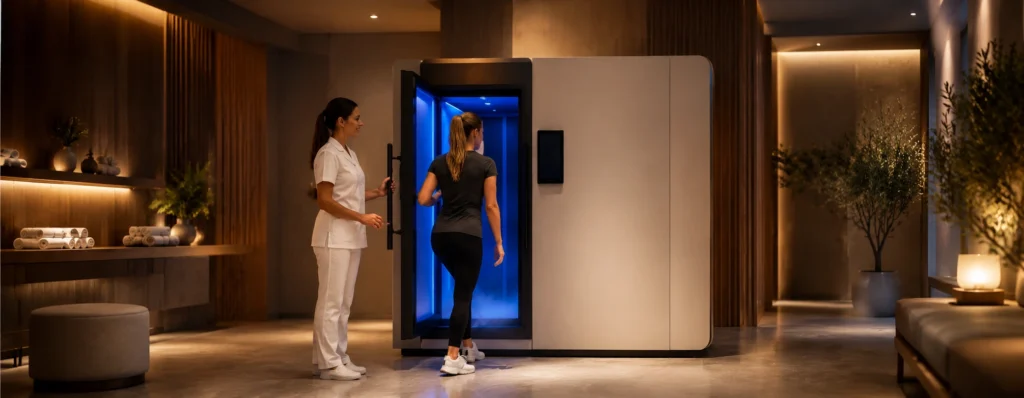
How does a cryotherapy treatment work?
The exact procedure depends on the type of equipment and the protocol of the given provider, but it generally consists of a few simple steps:
- Before the treatment it is reviewed whether any excluding circumstance applies.
- The guest enters the chamber in appropriate, dry clothing. The hands and toes are particularly sensitive to cold, so depending on the protocol gloves, socks or other protective clothing may also be used.
- The temperature of the air in the chamber is extremely low, while the time spent inside is short – typically a few minutes. Staying inside longer does not necessarily mean a greater effect; on the contrary, it may increase the risk of a cold injury.
- After the treatment the guest returns to normal room temperature: the body gradually warms up again and the circulation in the skin increases. Many people report freshness, a feeling of warmth or lightness immediately afterwards.
What should you pay attention to before the treatment?
- The skin and the clothing should be dry – moisture can significantly increase the risk of a freezing injury in extreme cold.
- It is not advisable to enter the chamber immediately while heavily perspiring.
- Jewellery and metal objects generally have to be removed, because metal can cool down very quickly.
- In every case it is worth following the safety protocol belonging to the given equipment and provider.
What can you feel during the treatment?
The first sensation is of course the intense cold. Since the treatment is short and the air is dry, however, many people experience it differently from, for example, immersion in cold water. Tingling, a tightening of the skin or a strong sensation of cold may occur.
The treatment is not about „enduring” the cold. If someone experiences pain, numbness, unusual dizziness or any other unpleasant symptom, the treatment has to be stopped.
How many sessions are needed?
There is no answer to this that applies to everyone. Some people try it as a one-off experience, others use it regularly, adjusted to their sports load. In research, protocols consisting of several treatments are often studied, but there is currently no generally accepted number of treatments or frequency that is optimal for every purpose. One of the problems of the literature is precisely that the individual studies use different temperatures, treatment times and frequencies. You can find information about the sessions and passes available here on the Our prices page.
Cryotherapy or cold water immersion?
Both use a cold stimulus, yet they are quite different experiences. In cold water, because of the good thermal conductivity of water, the body loses heat much faster; in a cryochamber the air temperature is much lower, but dry air draws heat away more slowly. This is precisely why a –110 °C cryochamber cannot simply be compared to an ice bath of a few degrees. On the basis of earlier research it is not yet proven that whole-body cryotherapy would in every case be more effective for sports recovery than simpler cold treatment methods.
Cryo sauna and cryochamber: are they the same?
In everyday language they are often used as synonyms, but technically there may be a difference. In a whole-body cryochamber typically the whole body, even the head, is in the cold environment, while in partial-body cryo saunas the head in many cases stays outside the cold space. The cooling technology may also differ: there are electric cryochambers and devices operating with other technologies. This matters because the results of research using different types of equipment cannot necessarily be compared directly.
What cryotherapy devices exist, and what is each of them good for?
The experience and the parameters of the treatment are largely determined by the technology with which the chamber or the body surface is cooled. In practice you may encounter four solutions.
Local cryotherapy devices
Handheld or stand-mounted devices that blow strongly cooled air onto a given body part – for example onto a painful knee, ankle or shoulder. A targeted, short treatment that is easy to dose and does not require changing clothes. In return it only acts on that area: it does not trigger a whole-body cold stimulus affecting the entire body.
Dry ice (carbon dioxide) local treatment
This is also a local method: carbon dioxide is delivered close to the skin, which evaporates and cools the surface very quickly. Its advantage is the extremely short treatment time; its disadvantage is that it can only be applied on a small surface and requires refilling from gas cylinders.
Nitrogen (partial-body) cryo saunas
These cabins cool by evaporating liquid nitrogen. They are typically partial-body (PBC) devices: the head stays outside the chamber. They reach very low temperatures quickly and represent a cheaper investment. It is important to know, however, that nitrogen vapour displaces oxygen from the air in the cabin – this is why the head has to stay outside, and this is why ventilation of the room and oxygen level monitoring are important. The temperature may become stratified inside the cabin (colder at the bottom), and the nitrogen supply has to be maintained continuously.
Electric cryochamber – this is what we use
An electric cryochamber cools the air of the chamber itself with a refrigeration circuit (compressor) system, without adding gas. This has several practical advantages:
- Real air of normal composition – you are not standing in nitrogen vapour, and the oxygen level of the cabin does not drop. This is why the head can also be in the treated space: this is whole-body cryotherapy (WBC).
- A stable, even temperature – there is no stratification in the cabin, so the treatment takes place with predictable, repeatable parameters.
- No gas cylinders and no refilling – there is no need to work with nitrogen, which is simpler and more predictable from both an operational and a safety point of view.
- Dry air – the sensation of cold is less unpleasant than in a moist environment, so many people find it easier to get through the few minutes.
- More comparable with the literature – a significant part of the research was carried out with whole-body chambers, so the protocol applied here is closer to the methods studied.
Which is good for what?
- For the targeted cooling of a defined area – a painful knee, ankle or shoulder – local devices are practical.
- If you are looking for a short cold stimulus affecting the whole body, a whole-body chamber is needed.
- The nitrogen cabin is a fast and cheaper solution, but the head is left out of the treatment and it requires separate attention to the oxygen level.
- The electric cryochamber provides whole-body treatment without gas, with a stable temperature – this is the solution we use.
This difference also matters because the research relating to cryotherapy was carried out with different equipment: the results of a nitrogen PBC cabin and an electric WBC chamber cannot necessarily be compared directly.
Is cryotherapy safe?
With an appropriate protocol, short-term cold exposure may be problem-free for most healthy people, but the treatment does have risks. Adverse events connected with cryotherapy have already been documented in the literature, so proper supervision and taking excluding factors into account are important.
- The possible dangers of cold therapy may include cold injury of the skin, numbness, circulatory complaints or other unpleasant reactions.
- The FDA also emphasises that the possible therapeutic effects of whole-body cryotherapy cannot be regarded as proven for every indication.
- It is therefore particularly important to avoid claims that cryotherapy „cures” diseases.
Who is cryotherapy not recommended for?
The exact contraindications may also depend on the equipment and the protocol applied. It is particularly important to consult a specialist or a doctor beforehand, for example, in the following cases:
- significant cardiovascular disease, serious circulatory problems,
- inadequately controlled high blood pressure,
- a condition involving sensitivity to cold, sensory disturbance,
- another serious underlying condition,
- pregnancy – a prior medical consultation is also justified in this case.
If someone is not sure whether the treatment is right for them, it is not worth guessing: ask for a medical opinion.
Cryotherapy and weight loss: does it really burn a huge number of calories?
Spectacular claims often appear in connection with cryotherapy, saying that a treatment of a few minutes burns several hundred calories. It is worth treating these with reservation. The body does indeed use energy to maintain body temperature, but there is currently no adequate evidence that a few minutes of whole-body cryotherapy on its own would cause significant or lasting weight loss. For weight reduction, energy balance, nutrition, regular exercise and lifestyle continue to be the basis.
Can cryotherapy help the condition of the skin?
The blood circulation and appearance of the skin are also often mentioned in connection with cryotherapy. A cold stimulus does indeed bring about temporary physiological changes in the circulation of the skin, but this is not the same as it being proven to treat skin conditions or to rejuvenate the skin in a lasting way. Among the treatments targeting the condition of the skin, red light therapy works on a different principle, and cryotherapy for recovery purposes should also be distinguished from dermatological cryotherapy.
When is it worth choosing cryotherapy?
Cryotherapy may be interesting primarily for those who want to build a short, intense cold stimulus into their recovery routine. Its most common aims include supporting recovery after sport, reducing the feeling of fatigue, improving comfort after physical exertion and the general wellness experience.
The best approach, however, is not to regard it on its own. It can complement other recovery procedures well – for example oxygen therapy or trace therapy – but it does not replace regular sleep, adequate fluid intake, balanced nutrition, exercise and, where needed, specialist medical or physiotherapy treatment.
Summary: what is worth knowing about cryotherapy?
Cryotherapy is a family of methods using extremely low temperatures. During whole-body cryotherapy for recovery purposes the body is exposed to very cold, dry air for a short time. It is used mostly for sports recovery, alongside muscle fatigue, to improve general well-being and for wellness purposes.
The research results are promising in several areas – particularly regarding the inflammatory response and subjective recovery – at the same time, the current evidence does not yet support every health claim commonly made about cryotherapy. This is precisely why it is worth regarding it as a modern recovery and wellness tool that, for certain people, can be a useful complement to an active lifestyle – but not a universal cure. The right equipment, a short and controlled treatment, following the safety protocol and taking individual state of health into account are all important parts of safe cryotherapy.
Try the cryo sauna
See how a treatment works here and book an appointment.