Innovative health-preserving and regeneration therapies in Budapest, at Mammut. Opening: autumn 2026


Red light therapy: how does it work, what is it used for, and what types of light and devices are there?
Red light therapy is one of the fastest-spreading recovery and aesthetic methods of recent years. It is available in the form of face masks, smaller handheld devices, panels and whole-body systems, while more and more research examines the effect of light of different wavelengths on cells, skin, muscles and recovery.
The method is often called photobiomodulation, PBM for short. Its essence is that light of a defined wavelength is delivered to the tissues at a power and for a duration that does not burn or damage the skin, but may modify biological processes. Here this technology is represented by the red light therapy represents.
„Light therapy” does not mean a single treatment. Blue, orange or amber, red and near-infrared light have different properties, and the device, wavelength, power, treatment distance and time applied all influence the actual dose.
What is photobiomodulation?
During photobiomodulation, non-ionising light is applied to influence cell functioning. In the red and near-infrared range, one of the most important assumed mechanisms in research is the modification of the functioning of the mitochondria.
Put simply, the mitochondria can be regarded as the „energy centres” of the cells. Red and near-infrared light may interact with certain light-absorbing molecules inside the cell, which may influence ATP production, the signalling processes of the cells, the functioning of growth factors and oxidative stress.
This does not mean that the more light we apply, the greater the effect will be. One important characteristic of photobiomodulation is that the dose matters: at too low an energy level a measurable effect does not necessarily occur, while too high a dose may also reduce the desired biological response. This is precisely why there are significant differences between the various treatment protocols in the literature.
Red, orange, blue and infrared light – what is the difference between them?
Lights of different colours are in fact electromagnetic radiation of different wavelengths. Generally, the greater the wavelength, the deeper it can penetrate into the tissues.
| Type of light | Wavelength | What it is studied for |
|---|---|---|
| Blue | approx. 400–500 nm | Acne-prone skin, surface antibacterial effect |
| Orange / amber | approx. 570–610 nm | Skin renewal, skin tone, pigmentation, sensitive skin |
| Red | approx. 620–670 nm | Collagen, fine lines, skin texture, wound healing, regeneration |
| Near-infrared (NIR) | approx. 810–880 nm | Deeper tissues, muscles, joints, whole-body regeneration |
Blue light
Blue light typically falls in the range of about 400–500 nm. It acts relatively superficially, so it is used primarily in skin-related applications. Its best-known area of use is the treatment of acne-prone skin: blue light may have an effect on Cutibacterium acnes bacteria, which play a role in the development of inflammatory acne.
A systematic review from 2024, based on 35 studies and 1,185 cases, found that visible light, particularly blue light, improved inflammatory acne lesions in several studies. The American Academy of Dermatology emphasises, however, that light treatments generally do not completely remove acne, and they are often used as a complement to conventional dermatological treatments.
It is important that blue light is not the same as red light therapy, and in high doses it may also cause oxidative stress, so the right parameters are particularly important.
Orange and amber light
Orange or amber light is found roughly in the 570–610 nm range. Considerably less research is available on this wavelength range than on red or near-infrared light, but some of the results are distinctly interesting. One frequently studied wavelength is 590 nm.
In a randomised study with 137 participants, researchers compared 590 nm amber and 660 nm red light: after four weeks and ten treatments the measured volume of wrinkles around the eyes decreased by about 30% on both sides. Other research examines light around 585–590 nm in connection with pigmentation and melasma, and in a smaller randomised study from 2026, 590 nm light gave favourable results for sensitive skin regarding redness, water loss and certain unpleasant skin sensations.
Orange or amber light is therefore examined mostly in connection with skin renewal, skin tone, sensitive or redness-prone skin, pigmentation and fine lines – the scientific background, however, is still less consistent than for red light.
Red light
Classical red light therapy devices often use wavelengths around 620–670 nm; 630, 633 and 660 nm are particularly common. This is one of the most researched photobiomodulation ranges. Red light reaches deeper into the skin than blue or orange light, so besides surface skin problems it also plays a role in the study of connective tissue and regeneration processes.
Research examines, among other things, collagen production, the signs of skin ageing, fine lines, skin texture, wound healing, hair loss, as well as pain and recovery. According to the American Academy of Dermatology, several studies found improvement in fine lines, uneven skin surface, pigment spots and some signs of ageing. According to an international expert consensus published in 2025, photobiomodulation has an appropriate safety profile in several clinical application areas, and no DNA-damaging effect was found in the case of red light.
Near-infrared light
Although it is no longer visible to the naked eye, a significant part of red light therapy systems also uses near infrared, that is NIR light – typically at wavelengths of 810, 830, 850 or 880 nm. The reason for this is that near-infrared light can penetrate deeper into the tissues than visible red light.
It is therefore particularly common in devices used for muscle recovery, joints, sports loads, deeper tissues, pain and whole-body regeneration. Modern whole-body systems therefore often use not only red light but a combination of red + near-infrared .
What devices can red light therapy be carried out with?
The right device depends primarily on how large an area you want to treat.
Local light therapy devices
These are smaller lamps, handheld devices or concentrated light sources. Their advantage is that a single area can be treated with them in a targeted way – common areas of application are the knee, the shoulder, the elbow, part of the face, a scar or a smaller muscle area. In this case the treatment is generally carried out from a shorter distance.
LED face mask
One of the best-known home solutions. The face mask is placed directly on the skin or a few millimetres from it, and many small LEDs illuminate the whole face. Some masks use only red light, others combine red, blue, orange and near-infrared LEDs. They are used primarily for skin renewal and as a complementary treatment for acne-prone skin. Home devices generally have a lower power than professional systems.
Red light panels
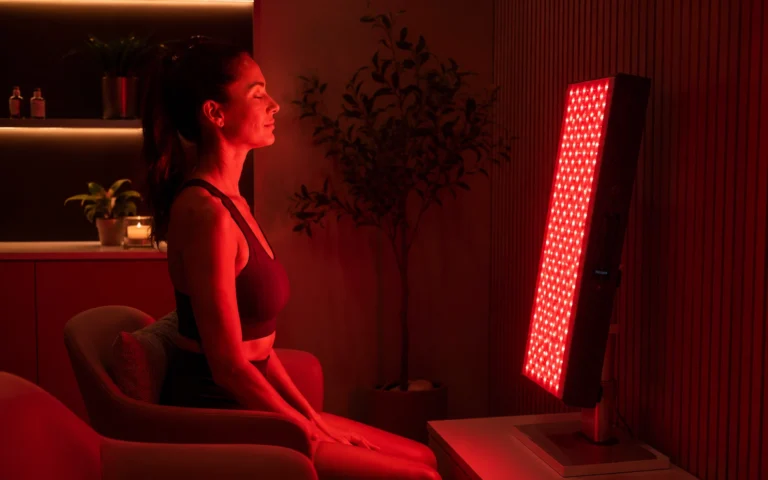
Panels can range from a few dozen centimetres up to systems the height of a person. Their advantage is that the distance between the area to be treated and the panel can be changed, so they can be used to treat the face, the back, the legs, the upper body, even almost the whole body; with larger systems several panels can be combined. With panels, however, it is particularly important to check at what distance the power stated by the manufacturer applies.
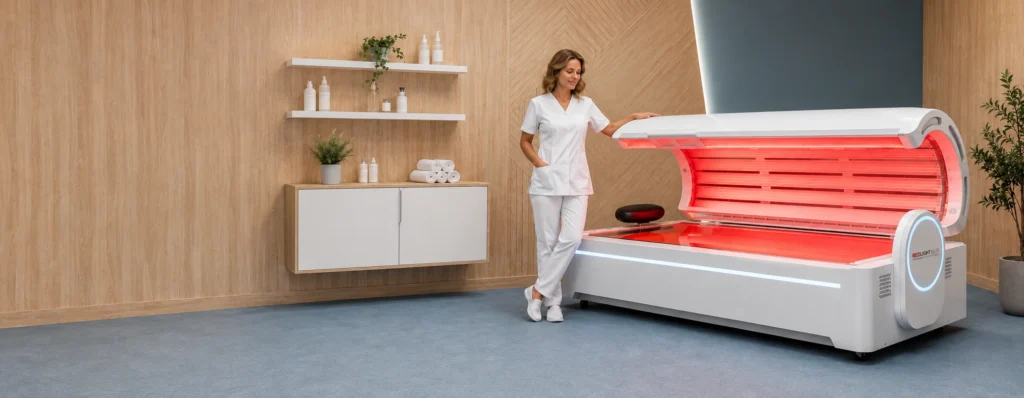
Whole-body red light bed
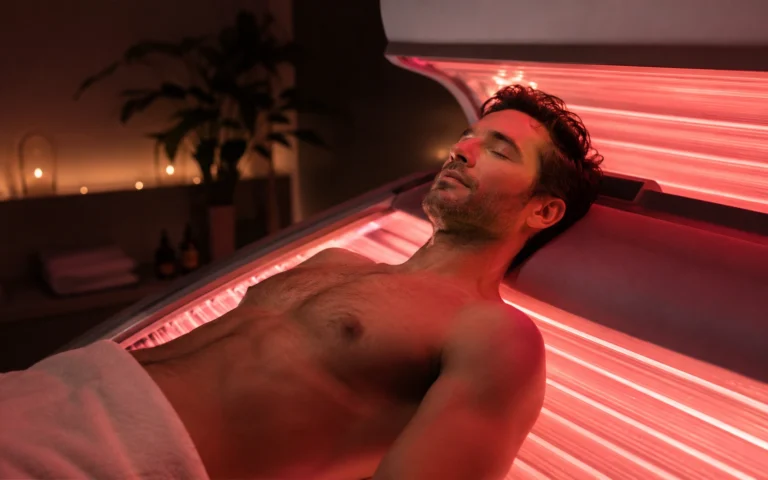
In appearance it may indeed resemble a conventional solarium, but technologically it is quite different: a conventional tanning solarium uses UV radiation, whereas a red light therapy bed uses red and/or near-infrared LEDs, and its aim is not to tan the skin.
One great advantage of a design that surrounds the whole body is even illumination. While with a panel the treatment distance and body position significantly influence the dose, in a properly designed whole-body system the light sources are close to the body and at a relatively even distance from it – so a large body surface can be treated at once.
What does power mean?
When comparing red light therapy devices, one of the most common misunderstandings is choosing on the basis of watts. With a „300 watt” or „1500 watt” device this generally refers to the electrical power.
From a therapeutic point of view, more important is the irradiance, that is how much light energy actually reaches the given skin surface. This is usually given in mW/cm² – for example 20, 50 or 100 mW/cm². The other essential figure is the dose or energy density, in J/cm²: this shows how much light energy reached one square centimetre during the whole treatment.
The simplified relationship is: dose = power density × time. For example an irradiance of 50 mW/cm² for 100 seconds: 0.05 W/cm² × 100 s = 5 J/cm². This is why a completely different dose can be delivered with the same device, depending on whether it is used for 2 or 20 minutes.
There is no single universal ideal value. Very different protocols are used in PBM research: according to a comprehensive review of the literature, many studies work with an irradiance below 100 mW/cm² and with an energy density ranging from a few J/cm² to roughly 10 J/cm², but higher doses are also applied. The appropriate value depends on the wavelength, the tissue to be treated, the goal, the treatment time, the distance from the skin and the design of the device – so the approach of „the stronger the better” is mistaken.
Who might find red light therapy interesting?
For recovery and wellness purposes it may be interesting primarily for people who:
- do sport regularly
- would like to support their recovery after training
- would like to improve the condition of their skin
- would like to reduce fine lines or signs of skin ageing
- would like to complement their general recovery routine
- would like to treat a larger body surface at once
In certain areas – for example skin renewal, androgenetic hair loss, some wounds and certain pain conditions – the literature shows favourable results, but the strength of the evidence differs significantly from indication to indication.
How does a whole-body treatment work?
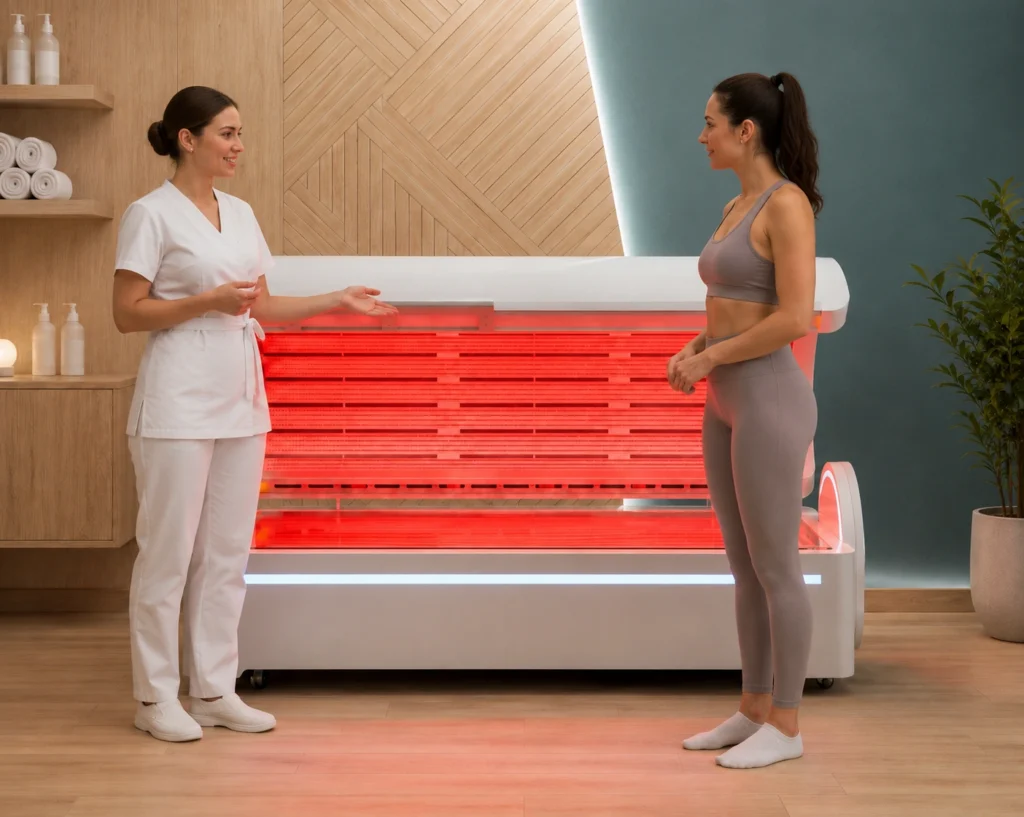
The treatment is generally simple and passive: the guest lies down or settles into the light therapy device, and the system illuminates the body for a defined period. A pleasant warmth can be felt during the treatment, but photobiomodulation is fundamentally not a heat treatment – red and near-infrared light is not the same as an infrared cabin or a sauna. Depending on the power and protocol of the system, the duration of the treatment can often range from a few minutes to about 15–20 minutes.
How many sessions are needed?
The effect of red light therapy is generally not studied on the basis of a single treatment. In research on skin renewal, for example, several sessions a week over several weeks were applied: in the study comparing red and amber light, ten treatments were carried out over four weeks, and in a 2025 study a combination of yellow, red and infrared light was applied three times a week for eight weeks. This shows well that photobiomodulation should be understood as a regularly repeated treatment rather than a one-off intervention.
Is red light therapy safe?
Applied properly, red light therapy is generally regarded as a low-risk method. Red light is not UV light, so it does not damage the skin by the same mechanism as sunbathing or a tanning solarium; according to the AAD there is currently no evidence to suggest that red light therapy causes skin cancer.
This does not mean, however, that it can be applied without limit under all circumstances. Temporary redness, mild irritation, eye strain and, rarely, an unpleasant feeling of warmth may occur. Appropriate eye protection may be important depending on the type and power of the device.
Who needs to be particularly careful?
In the case of conditions or medicines causing photosensitivity it is worth consulting a doctor. These may include, for example, certain antibiotics, dermatological medicines, immunological conditions or conditions involving photosensitivity.
The American Academy of Dermatology also points out that in the case of darker skin tones visible light may, under certain circumstances, increase pigmentation. With blue light, the right dose is particularly important, because at higher energy oxidative stress may also develop.
Red light therapy or an infrared lamp?
They are not the same. A significant part of the operation of a classical infrared lamp is a heat effect, whereas photobiomodulation applies defined red and near-infrared wavelengths primarily to trigger light reactions at cell level. So the fact that a lamp glows red or gives off heat does not necessarily make it a photobiomodulation device.
A home device or a professional system?
There can be a place for both. A face mask or a smaller panel is comfortable and can be used regularly at home. The advantages of a professional system may be:
- a larger treatment surface
- more uniform light distribution
- a more precisely controlled distance
- higher irradiance
- a shorter treatment time
- a professionally designed treatment protocol
A recent review of the literature on home LED devices found moderate-quality evidence for blue and combined blue-red LED devices applied to acne, while for other home devices the evidence was considerably weaker.
Is it worth investing in red light therapy?
Red light therapy and, in a broader sense, photobiomodulation is a non-invasive, light-based recovery method that uses light of a defined wavelength to influence the biological processes of cells and tissues. Not all light is the same.
- The blue light is examined primarily in connection with acne-prone skin and a surface antibacterial effect.
- The orange or amber light is interesting primarily in the areas of skin renewal, pigmentation, redness and sensitive skin.
- The red light is one of the most widely studied ranges, particularly from the point of view of skin regeneration, collagen production and general photobiomodulation.
- The near-infrared light reaches deeper into the tissues, so it is often used in combination with red light to support larger body surfaces, muscles and recovery.
The result of the treatment is not determined by the colour alone, however. The wavelength, the irradiance, the energy dose, the treatment time, the distance and the frequency are at least as important. This is why the value of a good red light therapy system does not simply lie in giving „strong light”, but in being able to provide an appropriate and reproducible light dose on the desired body surface.
Current research shows promising results in several areas of application; at the same time, the protocols are not yet fully consistent. This is precisely why it is worth regarding red light therapy as a modern recovery and wellness method and, in certain cases, as a complementary therapy – rather than as a universal treatment that solves every problem.
Try red light therapy
See how a whole-body treatment works here and book an appointment.