
Innovative health-preserving and regeneration therapies in Budapest, at Mammut. Opening: autumn 2026


Vein massage and compression massage: how it works, what it is used for, what cuffs exist and who it may suit
The term "vein massage" is most often used to mean intermittent pneumatic compression, or IPC for short. This is a mechanical compression treatment that applies rhythmic pressure to the limbs using air-inflatable cuffs. The aim of the treatment is primarily to support venous return and fluid flow.
This is why it is used in healthcare settings, as a complementary treatment for lymphoedema and venous problems, but in recent years it has also become increasingly widespread for sports recovery and wellness purposes. At our centre this technology is represented by the air compression massage represents.
One advantage of the method is that it can be used not only on the legs: there are also arm, hip, waist and full lower-body cuffs. Professional systems work with several independent air chambers, so the pressure does not reach the whole limb at once but travels along it in a defined order.
It is important to distinguish between pleasant compression massage for regeneration purposes and medical compression therapy applied to treat medical conditions. The same technological principle can be used for several purposes, but the pressure applied, the programme and the indication may differ significantly.
What is vein massage?
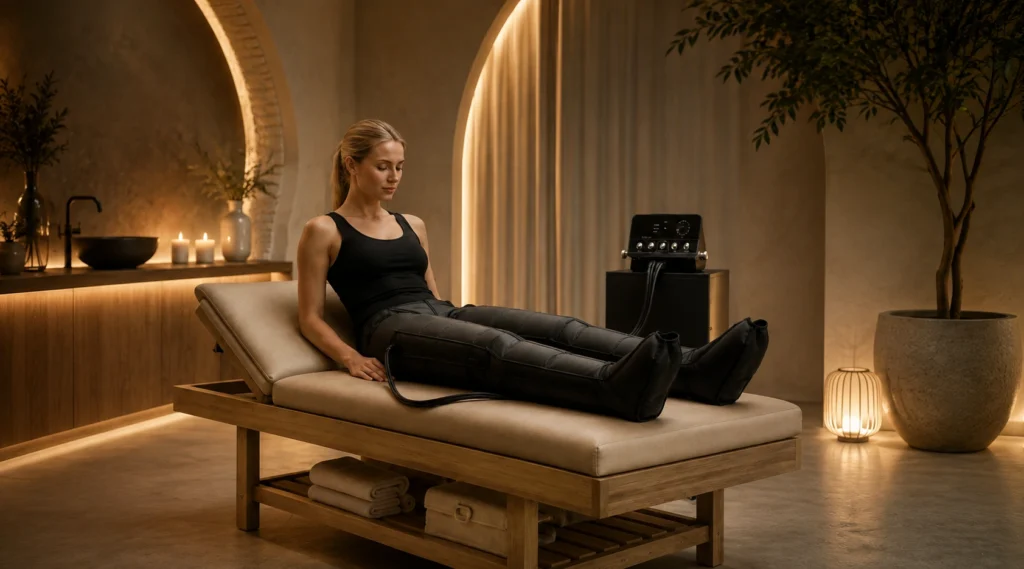
Vein massage is not manual massage in the traditional sense. The guest puts on one or more special cuffs containing air chambers, which the device inflates and then deflates in a defined order with the help of a compressor.
With a leg cuff, the pressure usually starts from the foot or the ankle and then gradually moves in the direction ankle → lower leg → knee → thigh . This movement follows the natural direction of the body's venous and lymphatic circulation. The compression mechanically squeezes the soft tissues and the vessels, so it may temporarily increase the movement of fluid accumulated between the blood and the tissues towards the centre of the body.
IPC has therefore long been used in healthcare settings as well. According to clinical guidelines it can be used, among other things, for the prevention of thrombosis, in severe chronic venous insufficiency, and as a complementary treatment for certain types of oedema and for lymphoedema.
How does pneumatic compression work?
Under normal circumstances, blood has to return from the legs to the heart against gravity. Important roles in this are played by:
- the valve system of the veins
- the contraction of the muscles
- especially the so-called muscle pump of the lower leg
When we walk, the contraction of the lower leg muscles mechanically squeezes the deeper veins and helps the upward flow of blood. During longer periods of sitting or standing this muscle pump is less active, which is why the legs may feel heavy, may swell by the evening, or a feeling of tightness may appear.
The pneumatic compression system tries to imitate this pumping mechanism with external pressure: the chambers of the cuff inflate one after another and then deflate, creating a rhythmic pressure wave.
What happens to the lymphatic system?
One of the tasks of the lymphatic system is to transport fluid accumulating between the tissues back into the circulation. If lymph drainage is inadequate, fluid may build up between the tissues, which can lead to swelling, tightness and, in more severe cases, lymphoedema. The mechanical pressure of compression treatment may promote the movement of interstitial fluid.
This is why IPC can be a complementary tool in the complex treatment of lymphoedema. A systematic review published in 2026 found, on the basis of seven randomised studies, moderate-certainty evidence that IPC may reduce the volume or circumference of lower limb lymphoedema.
It is important to note, however, that in the case of lymphoedema IPC is generally not used as a stand-alone treatment. It is often part of a complex programme that may include compression garments, exercise therapy, skin care, manual lymphatic drainage and an appropriate lifestyle. For upper limb lymphoedema, for example following breast surgery, the research results are more mixed: according to a 2024 meta-analysis, adding IPC to conventional decongestive treatment did not bring a significant additional effect on every outcome measure.
What does sequential compression mean?
Simpler devices inflate a single large air chamber. More modern devices, by contrast, work with a multi-chamber, sequential system: a leg cuff, for example, may contain 4, 6, 8 or even more separate air chambers. The machine first inflates the lowest chamber, then the next, and so on – this creates a wave-like pressure.
In more advanced systems the chambers may partly overlap, so there is less chance that an untreated area remains between two air chambers.
What cuffs exist?
Leg cuff – the most common solution
The best-known version of compression systems is the long, boot-like leg cuff. Depending on the model, this may cover the foot, the ankle, the calf, the knee and the thigh; the two legs are usually treated at the same time. Leg compression may be of interest primarily to those who:
- stand a lot
- spend long periods sitting
- feel their legs are heavy by the evening
- do sport
- are looking for recovery after training
- are prone to mild leg swelling
In the case of a medical indication the use may of course be considerably more complex than this.
Arm cuff
The technology can also be used on the upper limb. The arm cuff usually starts from the hand or the wrist and moves towards the shoulder. It may be used, for example, in the case of upper limb oedema, to support lymphatic circulation, as part of rehabilitation following certain operations, or after sporting exertion.
IPC has been studied in detail particularly in the case of arm lymphoedema developing after breast surgery. Based on current research it may have a role in treatment, but it is not necessarily better or more effective on its own than conventional complex lymphoedema treatment.
Hip, waist and trouser cuffs
Some professional systems are able to treat not only the limbs but also the area around the hips and the pelvis. There are hip cuffs, waist cuffs and "trousers" covering the whole lower body.
The main advantage of this is that the treatment does not end at the upper part of the thigh. If, for example, the aim is to move fluid towards the central regions of the body, it may be important for the treatment to cover the proximal areas – that is, those closer to the trunk – properly as well. The appropriate type of cuff should therefore always be selected according to the treatment goal.
How does a compression massage work?
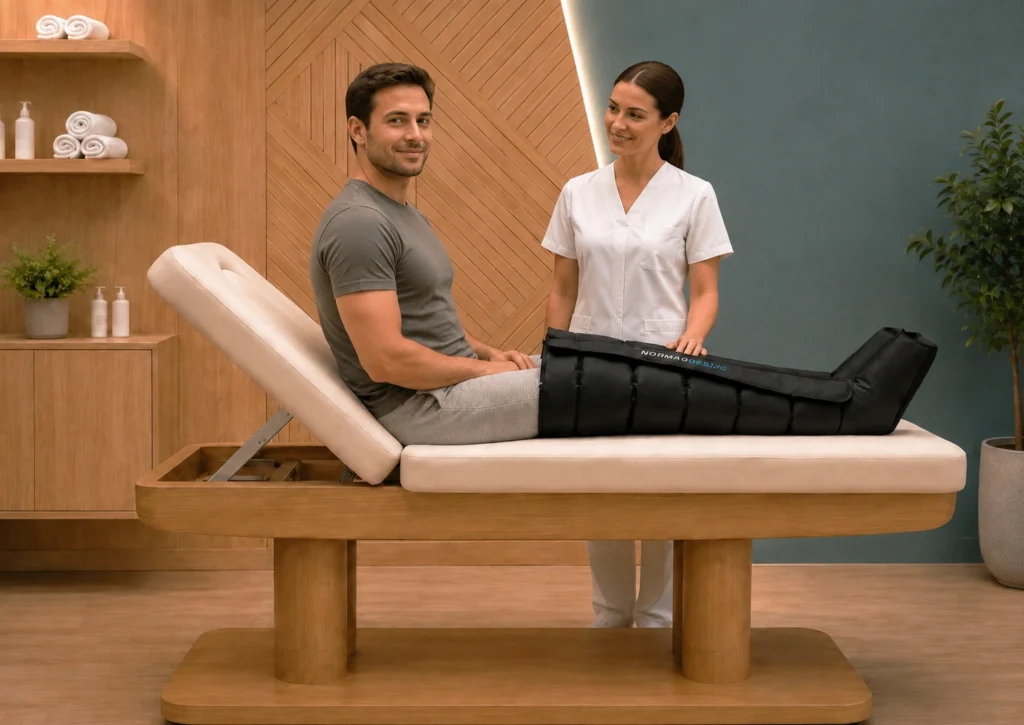
The treatment usually takes place lying down or half-lying. The guest puts on the appropriate cuff, then the practitioner sets the pressure, the treatment time, the compression programme and, in some cases, the operation of the individual chambers. The cuff then inflates and deflates rhythmically.
The sensation can generally be compared to someone gradually and firmly squeezing the leg or the arm, then letting go. The treatment should not be painful.
What pressure does it work with?
The pressure is usually given in mmHg, that is, millimetres of mercury – the same unit we use for blood pressure. The appropriate value depends significantly on the device, the treatment goal, the cuff, the state of health and the treatment area.
In a 2024 systematic review dealing with sports recovery, the most frequently applied protocols used a pressure of around 80 mmHg and a treatment time of 20–30 minutes. This does not mean, however, that this is the ideal setting for every purpose: in medical treatment substantially different protocols may be applied. The right pressure is therefore not a matter of "the higher the better".
How long does a treatment take?
The duration of a treatment can generally range between about 20 and 60 minutes, but the exact time always depends on the given system and treatment goal. In research on sports recovery a duration of 20–30 minutes is common; in studies dealing with the treatment of lymphoedema, longer and regularly repeated treatments have also been used. At the same time, there is no uniform, mandatory IPC protocol in the literature for every indication.
What is compression massage used for?
Heavy leg sensation and venous congestion
Compression can support venous return. In the case of chronic venous problems, guidelines state that IPC can be used to reduce venous oedema and certain painful venous symptoms. In a wellness setting it is therefore often chosen by people whose legs feel heavy and tight after long periods of sitting or standing.
Oedema
Pneumatic compression can mechanically help to move fluid accumulated in the tissues. This is particularly important in the case of medical oedema, but in such cases the cause of the condition must always be clarified first. Leg swelling is not a single disease, and it may have completely different causes, for example:
- venous insufficiency
- lymphoedema
- heart failure
- kidney disease
- medication side effect
- thrombosis
For this reason, leg swelling of unknown origin, of recent onset or affecting one side only must not simply be treated with compression massage.
Lymphoedema
This is one of the areas where IPC may have a genuine clinical role. Based on the most recent studies, in the case of lower limb lymphoedema IPC, when applied appropriately, may be able to reduce the volume of the limb. However, it is generally used as a complementary therapy rather than as a replacement for complex lymphoedema treatment.
Sports recovery
Compression boots have become extremely popular among athletes in recent years: after training or competition many people use them for muscle fatigue, heavy legs, muscle soreness and recovery. For many people the experience is distinctly pleasant, but the scientific results are more restrained.
A 2024 systematic review and meta-analysis, based on the results of 17 studies with a total of 319 participants, concluded that IPC may bring a small improvement in certain recovery indicators, and that its benefit may lie primarily in reducing perceived muscle pain or muscle tenderness. A more recent review from 2025, however, found no clear evidence that it is better than other recovery methods, and according to another 2025 meta-analysis IPC showed no convincing effect on reducing muscle soreness measured 24 hours after training.
For athletes, then, it is better regarded as a comfortable recovery tool rather than a proven performance-enhancing method.
Does pressure therapy "detoxify"? Pneumatic compression can indeed promote the flow of venous and lymphatic fluid, but this does not mean that the device literally "drives the toxins out" of the body. Processing and excreting the body's metabolic products is primarily the job of the liver, the kidneys, the lungs and the intestinal system. It is therefore more accurate, professionally speaking, to say that the treatment may support fluid flow and lymphatic circulation.
Compression stockings or mechanical compression?
They are not the same. A compression stocking applies continuous, defined pressure to the leg, whereas pneumatic compression applies periodically changing pressure.
| Aspect | Compression stocking | Mechanical compression |
|---|---|---|
| Nature of the pressure | Continuous, constant | Rhythmically changing, wave-like |
| Use | Can be worn all day | Periodic, treatment of a few tens of minutes |
| Adjustability | By size and compression class | By pressure, programme and chambers |
| Typical purpose | Lasting support in everyday life | Targeted treatment or recovery |
Vein massage or manual lymphatic massage?
These are not the same either. Manual lymphatic drainage is a special treatment technique performed by hand, while pneumatic compression works with a machine using a predefined pressure programme. In certain cases the two may complement one another, but the machine does not automatically replace treatment performed by a trained lymphatic therapist.
What should we look for when choosing a cuff?
A good cuff is not simply "as tight as possible". It is worth paying attention to the following:
- How many air chambers does it consist of? A multi-chamber system may allow finer, more gradual compression.
- Do the chambers overlap? This may result in a more even distribution of pressure.
- How large an area does it cover? A short calf sleeve cannot do the same as a cuff treating the whole leg.
- Can the individual chambers be controlled separately?
- What pressure range can be set?
- Are there several treatment programmes?
- Can it also treat the foot?
These say more about the usability of a device than the maximum pressure on its own.
When should compression massage not be used?
Compression treatment must not be applied automatically to every swelling or leg pain. It is particularly important to consult a specialist beforehand in the case of, for example:
- known or suspected acute deep vein thrombosis
- severe peripheral arterial circulatory disorder
- decompensated or severe heart failure
- acute skin infection
- an open or untreated wound
- suddenly developed limb swelling of unknown origin
- significant impairment of sensation
The international consensus explicitly emphasises that risk factors must be assessed and a proper fit checked before compression treatment. In a hospital setting IPC is used precisely for the prevention of thrombosis, for example in immobile patients, but this does not mean that it could be used safely at home in the case of existing or suspected acute thrombosis.
Can the treatment be unpleasant?
With appropriate settings, a pleasant, rhythmic squeezing sensation is generally experienced. With improper use, painful pressure, numbness, skin irritation, uncomfortable tightness or excessive compression may occur. If the limb turns pale or blue, or pain, impaired sensation or unusual coldness appears, the treatment must be stopped.
Home compression boots or professional treatment?
Many home devices are available today. For recovery after sport, a simpler system may also be suitable, provided the person is healthy and uses the device according to the instructions. The advantages of professional devices may include:
- more air chambers
- more precise pressure control
- more programmes
- different cuffs
- treatment of a larger body surface
- settings personalised by a specialist
In the case of a health complaint, the indication and the appropriate protocol are substantially more important than the brand of the device itself.
Who might find it interesting for wellness and recovery purposes?
For healthy people it may be a pleasant complementary method primarily for those who:
- stand or sit all day
- travel a lot
- do sport intensively
- feel their legs are tired after training
- would like to support their recovery
- are looking for a pleasant, passive treatment
In such cases the treatment may be attractive mainly because of the lighter feeling in the legs, the comfort and the relaxation.
How many sessions are needed?
There is no universal answer to this either. A healthy athlete may use it occasionally, after heavier loads; for wellness purposes a few sessions a week may also be considered. In the case of a medical problem – for example lymphoedema or chronic venous insufficiency – a completely different treatment programme is required, determined by a healthcare professional. Studies apply very different treatment times, pressure values and frequencies, so at present there is no "ideal" protocol valid for every situation.
Summary
Vein massage, that is, intermittent pneumatic compression, is a mechanical treatment that applies rhythmic pressure to the limbs using air-inflatable cuffs. Sequential systems create a compression wave moving from the foot or the hand towards the trunk, thereby supporting venous return and the movement of fluid. The devices include compression boots treating the whole leg, arm cuffs, hip cuffs, waist and abdominal units, and systems treating the entire lower body.
In a healthcare setting IPC has well-defined areas of use, including thrombosis prophylaxis, venous oedema and the complementary treatment of certain types of lymphoedema. For sports and wellness use the evidence is more restrained: based on current research, compression boots may make recovery more pleasant and may reduce perceived muscle pain, but it has not been demonstrated that on their own they significantly speed up the restoration of objective muscle performance.
Vein massage is therefore best regarded as a passive recovery method that supports circulation and the feeling of comfort, and which, with the appropriate indication and settings, may also serve medical purposes – but not every leg swelling or circulatory complaint can automatically be treated with it.
Try air compression massage
See how a treatment works here and book an appointment.